
Buying a second-hand piano
A good second-hand piano is worth having, but many of the pianos sold cheaply or given away need far more than a tuning. Here's what Benni checks, and what to ask before you pay or take one away.
Download the viewing form (PDF, two pages) to fill in on your phone or print and take with you.
Is a second-hand piano worth buying?
Yes. But a piano is worth roughly the maintenance that has gone into it in recent years, not its age or the manufacturer on the fallboard. Spending a little more on a piano that has been looked after is better than paying $1 for one that hasn't been tuned in 40 years.
What to ask the seller first
- When was it last tuned? A piano tuned regularly has been looked after. A piano that hasn't been tuned in many years will very likely need a pitch raise, and possibly other repairs.
- Where has it been kept? Humidity is a piano's worst enemy: it makes the wood swell, grows mould and corrodes the metal parts. Changing temperature is the next worst: as a piano swings between hot and cold, the string tension keeps dropping and nothing stays in tune. A garage or shed has both, so a piano kept in one for years almost certainly needs major work.
What to look for when you view a piano
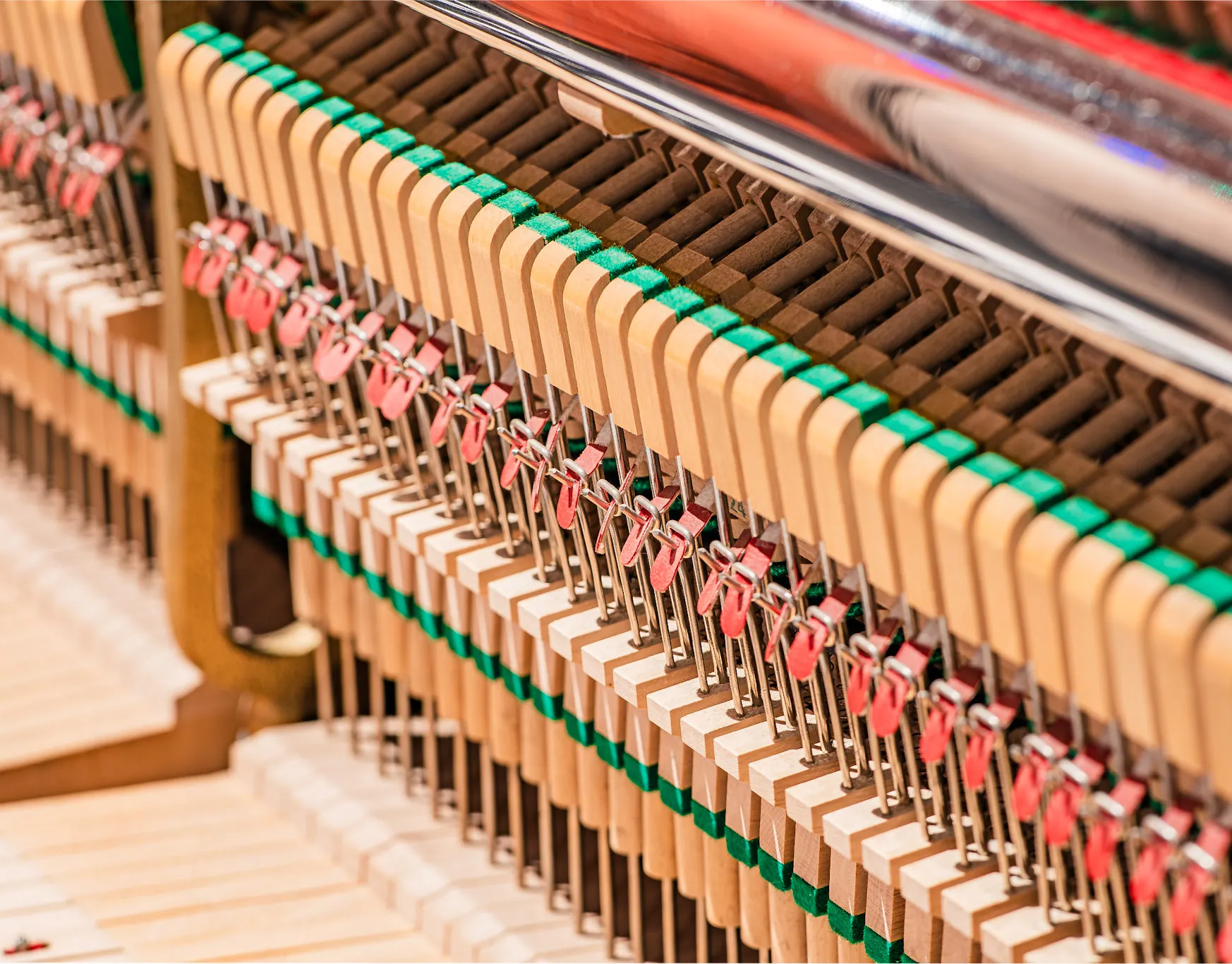
Open the lid and look at the hammers. Deep grooves worn into the hammer felt by the strings show how much the piano has been played. When the grooves are pronounced, the hammers no longer strike the strings cleanly, and the strike produces inharmonic overtones instead of a clean sound.
Look along the row of hammers, too. Uneven gaps between them mean the action is out of alignment. That can be put right, but it is another regulation, and a piano far out of regulation can have keys that don't sound, or that return so slowly you can only play them every few seconds.
Look for the damage left by pests and damp: mouse droppings, felts eaten by moths, borer damage in the wood, and mould. Mouldy hammer felt turns dark grey and spotty, and it never comes out. Dust can be cleaned; mould can't.
Play every key. If you have a tuner, check the A above middle C: if it is 10 cents or more below 440 Hz, the piano will very likely need a pitch raise. In most cases that is three tunings ($540 + GST in total): the first two bring the strings up to pitch, and the third is the normal fine tuning. A stable piano sometimes needs only two.
Faults that rule a piano out
- a crack in the cast-iron frame
- cracks in the soundboard, or a structural crack anywhere else, such as in the case
- snapped copper-wound bass strings. Each one has to be measured and made to order, often from overseas, and a replacement costs upwards of $600 + GST per string. On most second-hand pianos that isn't worth it, and Benni doesn't replace them.
- loose tuning pins, common in pianos around 100 years old. Many older pianos have no cast-iron plate covering the pinblock, the wooden block that holds the pins, so decades of string tension pull the pins down: gaps form above them and widen over time. The piano can still be tuned, but it won't hold the tuning for long. Tuning pins can be hammered further into the pinblock to tighten them. Where that has already been done, there may be no room left, and the pins would have to be replaced, which is almost never worth it.
Faults that can be fixed
- Keys that make no sound. Very common, and usually caused by humidity and changes in temperature: the wood swells, which causes friction on the small moving parts, and the friction stops them triggering the hammer when the key is pressed. Most key faults can be repaired, often with an adjustment. Benni's key repairs cost from $45 + GST per key, with bulk discounts when many keys need repairs.
- Snapped steel strings. Replacing a plain steel string is routine. Strings rarely break on their own; they snap where rust has weakened them. Many strings loop around a pin and come back as the next string, so one break often means two strings lost. A broken string must be taken out properly, or it buzzes against its neighbours.
Which manufacturers and periods to look for
- Avoid over-damper pianos. If a piano has its dampers above the hammers, it is an antique, well over 100 years old, and very likely near the end of its usable life. Its pins, soundboard and frame have to withstand a total string tension of around 20 tonnes, which can't be expected of a piano that age, so keeping one in tune takes an enormous amount of work. Look for an under-damper piano, with the dampers below the hammers. How to tell over-damper and under-damper pianos apart
- Yamaha uprights from the 1970s, '80s and '90s are a strong choice.
- German and other European manufacturers are generally good options.
- Weinbach, a brand made by the Czech manufacturer Petrof, is rare in New Zealand, but Benni has always found them particularly good.
The well-known brands are good too, and they generally hold their value.
How much should you pay for a second-hand piano?
For a good piano that has been serviced recently, Benni would look between $500 and $1,500. You can spend less or more, but in that range you can find a genuinely good piano.
Budget for what comes after. Almost every second-hand piano needs a tuning after the move, and one that has been neglected needs a pitch raise. Benni once bought a lovely old Weinbach upright for $700; with the pitch raise and the work it needed, it came to about $1,500.
To judge a price, ask what has been done. A piano at concert pitch is worth at least the cost of a pitch raise more than one that isn't. If it needs no repairs or regulation, add a couple of hundred dollars. A piano regulated in the last year or two, with its hammers reshaped, is worth more than an untouched one of the same age.
Is a free piano worth it?
It can be, as long as you know what you're taking on. Many free and $1 pianos are given away to save the owner the cost of moving them and taking them to the dump. People who have never owned a piano often assume one tuning will put it right. It almost never does: think of a car that has sat in a garage for 30 years, which needs far more than an oil change to pass a WOF.
A neglected free piano usually needs a pitch raise and repairs, often $500 to $1,500 or more, on top of moving it. At that point a $500 piano that doesn't need a pitch raise can be the cheaper choice. And it is hard to sell a neglected piano later: there are plenty around, and the ones that sell have been tuned and kept at concert pitch.
Be wary of "free piano" listings that ask you to pay a delivery fee upfront to a third party: this is a common online scam.
Getting it home
- Check it fits. Before you buy, make sure the piano can get through your front door and into the room where it will stand.
- Moving. Benni doesn't move pianos, but piano moving companies do. Many charge extra for steps and difficult access, and moving a piano is much cheaper as part of a house move than on its own.
- Where it stands. Put it against an internal wall, away from windows and outside walls, out of direct sun and away from drafts. Sun warming a piano during the day is a recipe for it constantly going out of tune.
- Let it settle. Wait two or three weeks after the move before the first tuning, so the piano can adjust to its new room.
Buying a piano in Wellington
Everything above applies anywhere. In Wellington, a few things come up again and again.
Expect a pitch raise
The great majority of pianos in Wellington haven't been maintained for decades, not just a few years: about every second tuning Benni does needs a pitch raise first. Unless the seller can show it has been tuned recently, budget for one ($540 + GST) on top of the price.
Check the strings for rust
Many Wellington pianos have rust and corrosion on their strings. Strings in that state are prone to snap during a pitch raise: raising the pitch adds a lot of tension, and a string breaks at its weakest point.
Steps and tight entrances
Many piano moving companies charge extra for steps and difficult access, so a house up a long flight of steps won't be cheap to deliver to. Many Wellington houses also have a small, sheltered entrance built against the wind, and an entrance with little room to turn a piano can be a showstopper, although many piano movers can stand a piano on its side to get it in. Check before you commit.
Have Benni check it before you pay
Found one on Trade Me or Facebook Marketplace? For $90 + GST ($103.50 incl. GST), Benni inspects the piano where it is, checking every major part, and tells you on the spot what he thinks of it and what it's worth. If you'd like it in writing, a short written summary makes it $180 + GST ($207 incl. GST). Travel to the seller is included anywhere in Wellington, Lower Hutt, Upper Hutt, Porirua and Kāpiti; Ōtaki and the Wairarapa by arrangement, small travel surcharge.
Book a pre-purchase inspection, book one with a written summary, or call 0800 244 049.
Book a tuning
New customers welcome. Call or send a message and Benni will find a time that suits you, evenings and weekends included. $190 + GST, with travel included across Wellington, Lower Hutt, Upper Hutt, Porirua and Kāpiti.