
Piano regulation
Tuning looks after the pitch. Regulation looks after the touch: how evenly the keys respond, how quickly notes repeat and how cleanly they stop.
Why regulation matters
For most pianos in a home, a tuning at least once a year plus regulation and voicing every five to ten years keeps the instrument performing as it should.
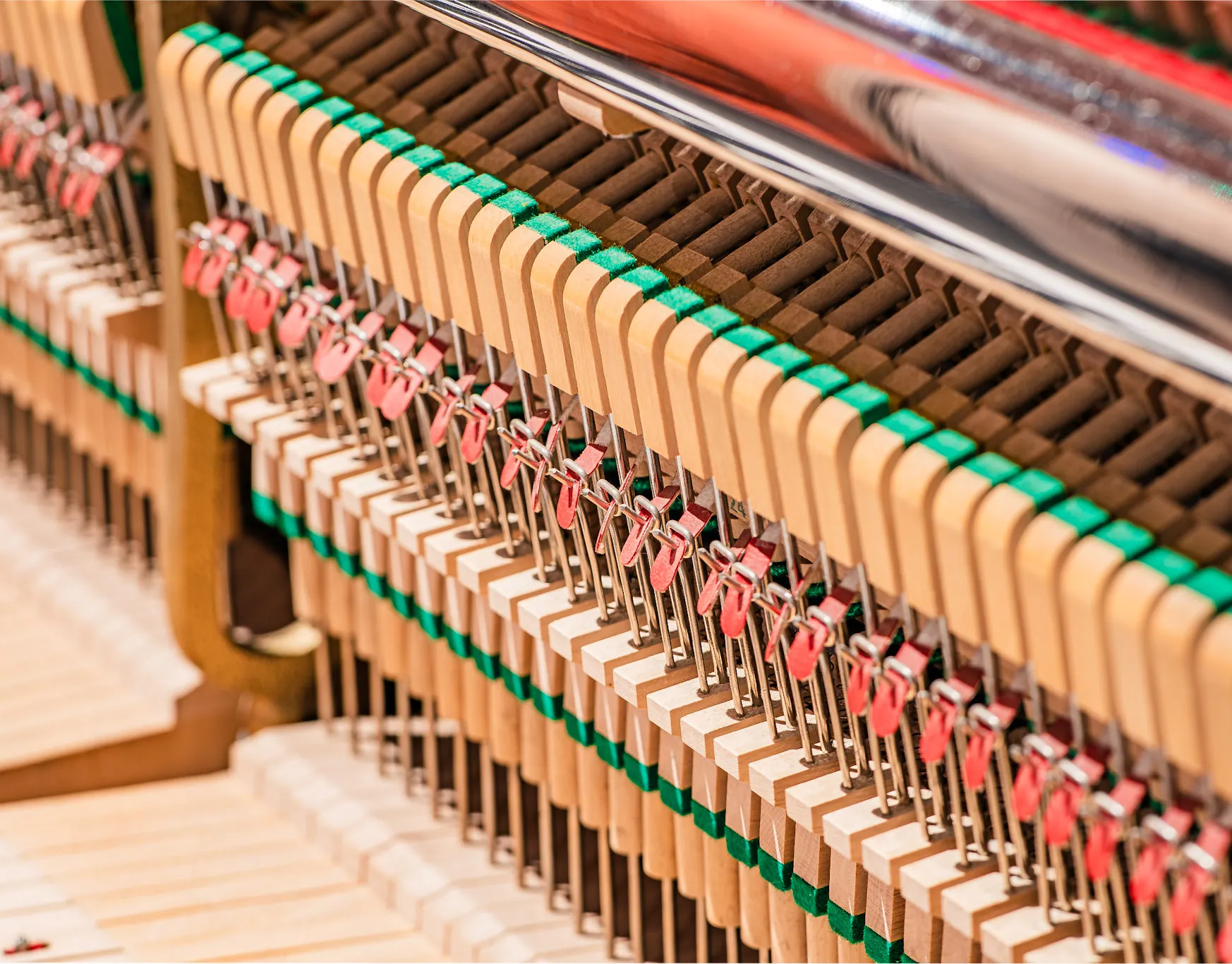
The action has thousands of moving parts. Through normal playing and changes in humidity they wear, compress and drift out of alignment, so touch, repetition, control and responsiveness all suffer, even while the piano still sounds in tune. Voicing matters too: hammer felt hardens and grooves with use, making the tone uneven or too bright. Regular regulation and voicing restore the balance, control and tone the piano was designed to have.
Two kinds of regulation
A piano has two parts that are regulated separately:
- The keyboard: the 88 keys you press. Keyboard regulation makes every key sit at the same height, go down the same distance and feel the same under your fingers.
- The action: the mechanism behind the keys that throws the hammers at the strings and lifts the dampers off them. Action regulation makes every note play, repeat and stop the same way.
Each can be done on its own: keyboard regulation is $450 + GST and action regulation $450 + GST. To regulate the whole piano you need both, which is a full regulation at $900 + GST. The keyboard always comes first, because the action is set to the keys: start with the action and it has to be done again once the keys are adjusted.
Which one does my piano need?
The signs usually point to one part or the other:
- Keyboard: keys sitting at uneven heights, keys that go down further than their neighbours, or keys that feel loose, wobbly or sluggish.
- Action: notes that don't repeat when you play quickly, notes that are hard to play softly or come out unevenly loud, hammers that bounce or strike twice, and notes that keep ringing after you let go.
If both sound familiar, or you aren't sure, Benni can check the piano at a tuning and tell you what it needs before any work is booked.
What keyboard regulation covers
- Cleaning. All 88 keys are removed and the keyframe is cleaned out underneath.
- Key bushings. The felt bushings that guide each key at the front and at its balance point are checked, eased or renewed, so every key moves freely without wobbling or sticking.
- Balance rail discs. Each key rocks on a pin in the balance rail, sitting on small felt and paper discs. These are renewed where worn, and adjusted to set every key to the correct, even height.
- Key depth. How far each key goes down is made even with paper discs under the front of the keys, so the touch is consistent across the keyboard.
- Spacing. The keys are spaced evenly, with even gaps between them.
What action regulation covers
- Hammers to strings. Each hammer is aligned to strike its strings squarely, and its travel set evenly for consistent power and control.
- Let-off. Each hammer is set to release cleanly just before it reaches the strings.
- Checking and repetition. Each hammer is caught quietly after it strikes, and reset quickly so notes repeat reliably at any speed.
- Dampers. The dampers are seated evenly and timed with the keys, so notes stop cleanly.
- Pedals. The sustain, soft and any other pedals are regulated for correct travel and an even effect.
- Cleaning and testing. The action is cleaned with compressed air, moving parts are lubricated with PTFE, and the piano is played across its whole range to fine-tune the touch.
Benni regulates to the standard specifications for each piano, so it plays the way its maker intended. The same stages apply to upright and grand pianos.
Regulation or overhaul?
Regulation adjusts parts that are still in good condition. It won't fix parts that are worn out. Hammers grooved deep by years of playing, worn-out key bushings and compressed or moth-eaten felts need repair or replacement first, and that is an overhaul.
An overhaul reshapes, repairs or replaces those worn parts and then includes a full regulation. It costs $900–$1,800 + GST, depending on how much needs doing, and Benni assesses the piano and quotes before starting.
Neither regulation nor an overhaul will turn a poor piano into a good one. They don't fix structural problems such as a failing pinblock or a cracked soundboard. They get the best out of a fundamentally sound instrument.
What does regulation cost?
Prices across the trade range widely: from about $200–$500 for a minor or partial regulation, to $1,000–$3,500 or more for a full regulation of a grand piano, which can take 10–15 hours. Benni's prices:
| Service | Price |
|---|---|
| Keyboard regulation (upright)All 88 keys removed and cleaned out underneath, key bushings checked and renewed where needed, and every key set to the correct height and depth with felt and paper balance rail discs, renewed where necessary. This significantly improves playability. | $450 + GST |
| Action regulation (upright)Adjustment of all 88 hammers and dampers and every other adjustable part of the action, and the pedals, with all moving parts lubricated with PTFE and the action cleaned with compressed air. | $450 + GST |
| Full regulation (upright)The keyboard and action regulations together. Both are needed to regulate the whole piano; the keyboard is done first, because the action is set to the keys. | $900 + GST |
| Full regulation (grand)The same full regulation for a grand piano. | $1,800 + GST |
| Piano overhaulFor a piano that needs more than adjustment: worn parts such as hammers, key bushings and felts are reshaped, repaired or replaced, and the keyboard and action are then fully regulated. Priced after an assessment. | $900–$1,800 + GST |
Book a tuning
Call or send a message and Benni will find a time that suits you, evenings and weekends included. $190 + GST, with travel included across Wellington, Lower Hutt, Upper Hutt, Porirua and Kāpiti.